Apple’s App Store Stubbornness May Be iOS’s Greatest Security Vulnerability


Angular Lets Developers Share Code Between Web And Mobile Apps

Angular's dream of being able to share code for web and mobile apps is becoming a reality today with a newly announced solution. The team announced developers can now build web and mobile apps once with Angular and NativeScript, instead of having to build both a web and native mobile app.
According to the team, developers have always been able to use NativeScript to build mobile apps with Angular. NativeScript is Progress' open-source framework for native mobile apps. Having to build a web app and then a build a native mobile app and the maintain those two apps separate "got the job done," the Angular team explained, but "it quickly became apparent that we could do better than that."
"This challenge led to a dream of a Code-Sharing Project. One that would allow you to keep the code for the web and mobile apps in one place. One that would allow us to share the business logic between web, iOS and Android, but still be flexible enough to include platform-specific code where necessary," Sebastian Witalec, senior developer advocate for Progress, wrote in a blog post on Angular.
The team was able to do this with Angular's Schematics and ng add features. Both teams set out to create nativescript-schematics, "a schematic that enables you to build both web and mobile apps from a single project," wrote Witalec. In addition, the team separates the web code from the mobile code with a naming convention. Developers can specify NativeScript code with .Tns and web code without the .Tns extension.
"The objective is to share as much code as possible, and break the platform-specific code into separate files," Witalec wrote.
The team also provides support for nativescript-schematics within the Angular CLI to create a new code-sharing project, convert a existing web project to enable code sharing and either create or transform existing components and modules into code-sharing formats.
"As you can see, building for both the web and mobile from a single project is fairly straightforward. You can either start with a fresh project (using ng new), or add mobile to an existing project (using ng add)," Witalec wrote.
Increasing Performance Of Angular Apps Through Change Detection And Component Reusing
Whether you are building enterprise applications, progressive web apps or e-commerce apps, there are many methods for enhancing your Angular application's performance. Some of the best ways for achieving high-performing and more efficient Angular apps is through change detection and component reusing. You may be wondering how change detection works in Angular or how to build reusable components. This article will explain the process, outline key strategies, as well as provide tips and best practices for your process to make it easier to accomplish your goals.
What is Angular Change Detection?In essence, change detection in Angular is the process of detecting when data changes in any app component. The JavaScript framework automatically updates the Document Object Model (DOM) and re-renders the view, displaying the changed values/objects to end-users. Here are the most basic ways in which you can trigger change detection:
A few quick facts to remember:
There are two Angular change detections strategies:
The process behind the Angular Default Change Detection strategy unfolds in the following way – for any change in any model property, Angular will run change detection traversing a component tree to update the DOM. You can manipulate the change detection tree using the following built-in methods provided by the ChangeDetectorRef class:
With Angular OnPush, it runs a change detector only when a new reference is passed to the component. If observable is passed to OnPush, then Angular ChangeDetector must be called manually to update the DOM.
Here is an Angular change detection example with OnPush.

We recommend using the OnPush Angular Change Detection strategy if you aim to optimize the performance of your Angular application. Angular OnPush strategy will reduce the unnecessary checks in child components which will make the whole application significantly faster. It checks for a change internally and stops all input reference variable updates from running change detection. If a component is not changed, the change detection won't go through it.
If you seek a more detailed explanation on how change detection in Angular works, read What Is Angular Change Detection & Change Detection Strategies.
The second approach for optimizing your app performance is through Angular component reusability.
Angular Component ReusabilityWhat exactly is Angular component reusability and how does it increase performance?
The more Angular code you hand write, the greater the likelihood for errors. However, with reusable components you reduce the bugs that can muck up your project. Component reusability in Angular becomes a great way for increasing performance across your entire app, reflecting on several key pillars:
Types of Reusable Components
There are two types of reusable components: container components and presentation components. Here is the difference between them:
Presentation components Container components They can be identified as simple components They are known as smart components They just need to get input data and display it in the UI They are connected to the services and know how to get data They are coded in an abstract way, without many relations, and can be reused easily They are tied to the business logic and it's hard for them to be reused or shared Angular Components Reusability Tips and Best PracticesHere are some quick steps for building reusable components in Angular:
Step 1: Avoid nesting styles when possible.
Step 2: Use variables for common items across the Angular app.
Step 3: Use UserControl to group markup and code into a reusable container, allowing the same interface and functionality to be used in several different places.
Step 4: Create style guidelines to promote code reuse.
Step 5: Don't make every component reusable – it will result in a non-maintainable, high coupling code.
Microsoft OpenAI-powered Copilot App Comes To IPhone And IPad
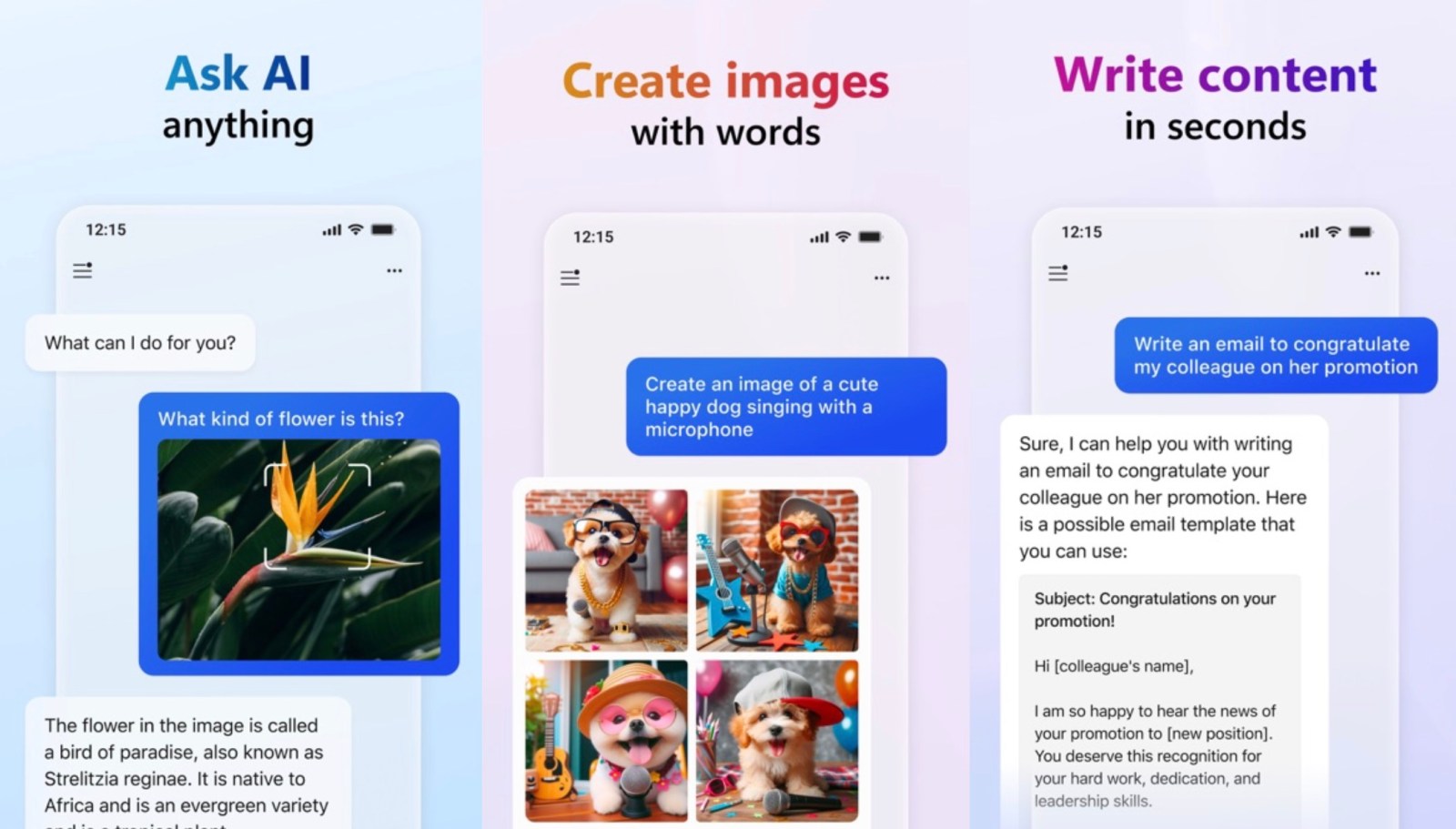
Microsoft's Copilot app is now available for iPhone and iPad users via the App Store. This app integrates the company's AI chat assistant technology, This story is supported by Mosyle, the only Apple Unified Platform. Mosyle is the only solution that fully integrates five different applications on a single Apple-only platform, allowing businesses and schools to easily and automatically deploy, manage, and protect all their Apple devices. Over 38,000 organizations leverage Mosyle solutions to automate the deployment, management, and security of millions of Apple devices daily. Request a FREE account today and discover how you can put your Apple fleet on auto-pilot at a price point that is hard to believe. Microsoft says: Copilot is a pioneering chat assistant from Microsoft Chat and create all in one place—for free! The launch of the dedicated Microsoft Copilot app comes after OpenAI launched its own ChatGPT app for iPhone back in May. Microsoft's Copilot app gives users an alternative way of accessing ChatGPT technology, separate from integration with Bing. The app is available on the App Store for free, with versions for iPhone and iPad. The iPad version of Microsoft Copilot can also be installed on any Mac Follow Chance: Threads, Twitter, Instagram, and Mastodon. FTC: We use income earning auto affiliate links. More.

Comments
Post a Comment